
You did everything right. You built topical authority, earned backlinks, and climbed to position one on Google for the terms that matter to your business. Then a prospect asked ChatGPT for a recommendation in your category, and your brand never came up. A competitor did.
This isn't a sign that your content got worse. It's a sign that where answers come from has changed, and the systems delivering those answers weigh different signals than the search engine you optimized for.
This guide covers what changed, how AI systems decide what to cite, the content and technical work that earns citations, platform-by-platform differences, and how to measure whether any of it is working.
TL;DR
AI platforms synthesize one answer from multiple sources instead of returning a ranked list of links, and the four terms used for this work (AEO, GEO, LLMO, "AI search optimization") are largely the same discipline wearing different labels.
AI assistant usage and zero-click behavior have both grown fast enough that invisibility in AI answers now carries a real, if still-debated, business cost.
Getting cited comes down to a sequence: matching intent, weighing authority, reading structure, and checking freshness, which is why direct-answer-first paragraphs, descriptive headings, and scannable formatting matter so much.
None of that matters if AI systems can't reach your content in the first place, so crawler access, renderable HTML, and accurate schema are the non-negotiable foundation underneath everything else.
ChatGPT, Claude, Gemini, Perplexity, and Copilot each pull from different indexes and reward different signals, so a single-platform strategy leaves visibility on the table, and citations from sources these systems already trust matter more than raw backlink volume.
The right starting sequence is audit, prioritize, fix technical access, optimize content, build authority, then monitor, and success is measured through share of voice, mention sentiment, and crawler logs, not click-through rate.
A handful of avoidable mistakes, more than weak content, account for most of the visibility gap between brands that show up in AI answers and brands that don't, which is why this has to be treated as an ongoing discipline rather than a one-time content refresh.
Before we get into what's changed in search, let's clear up one of the biggest sources of confusion.
If you're new to this topic, you've probably come across terms like AEO, GEO, LLMO, and AI Search Optimization. At first glance, they seem like four different disciplines. In reality, they're different names for the same core practice, each introduced by different people at different times as the industry searched for a standard term.
What Is AEO?
Answer Engine Optimization focuses on optimizing content for AI powered answer engines such as ChatGPT, Perplexity, and Gemini. Instead of showing users a list of web pages, these platforms generate direct answers. The goal of AEO is to structure your content so AI systems can easily understand it, trust it, and reference it when generating those answers.
What Is GEO?
Generative Engine Optimization describes the same objective from a slightly different perspective.
Rather than focusing on answer engines, it emphasizes generative AI systems that create synthesized responses instead of presenting ranked search results.
Although the name is different, the underlying goal remains the same. GEO is simply another way of describing the process of making your content more visible and useful within AI generated responses.
What Is LLMO?
Large Language Model Optimization (LLMO) shifts the focus to the technology behind AI assistants. Instead of emphasizing the products people use, LLMO focuses on the large language models that power tools like ChatGPT, Claude, and Gemini.
The term is often used when discussing technical concepts such as content retrieval, context selection, semantic understanding, and how language models determine which information to include in their responses.
What Is AI Search Optimization?
AI Search Optimization is the broad, marketing friendly term that encompasses all of these concepts.
It's the phrase you'll most often see in blog posts, product pages, and industry discussions because it's simple, easy to understand, and doesn't favor one specific terminology over another.
In most cases, when someone talks about AI Search Optimization, they're referring to the same practices described by AEO, GEO, and LLMO.
How Are These Terms Different?
Although the names are different, the differences are primarily in emphasis rather than strategy.
Term | Primary Focus | Commonly Used By |
|---|---|---|
AEO | Optimizing content for AI answer engines | SEO professionals and marketers |
GEO | Optimizing for generative AI systems broadly | Researchers and technical writers |
LLMO | Optimizing for large language models and retrieval | AI and machine learning practitioners |
AI Search Optimization | An umbrella term covering all of the above | Businesses, marketers, and the broader industry |
Once you look past the terminology, all four describe the same underlying objective: content that AI systems can discover, understand, trust, and reference accurately. You don't need a separate strategy for AEO, another for GEO, and another for LLMO. If your content is genuinely optimized for AI discovery, understanding, and citation, you're practicing all of them at once.
If you notice these terms used interchangeably across articles or conference talks, that's not inconsistency on the authors' part. It simply reflects an industry that hasn't agreed on one standard name yet. Focus on the underlying principle, not on which label wins.
What Changed
Picture the old model of search for a second. You type a question into Google, ten blue links come back, and you pick one. That entire model assumed a human would do the deciding.
AI answer engines throw that assumption out. Instead of handing you links to sort through, they read across dozens of sources, decide what the answer actually is, and just tell you. Sometimes they'll name where that answer came from. Often they won't bother.
It's a completely different job. A search engine's only real task is deciding which page deserves the top spot. An AI system has a harder task: it has to decide what to say, full stop, and then separately decide whether any source is worth vouching for by name. Ranking well for a keyword used to be the whole game. Now it's just one input into a much bigger decision the AI is making on its own.
Here's the split laid out plainly:
Factor | Traditional Search | AI Answer Engines |
|---|---|---|
Output | A ranked list of web pages | A single synthesized answer generated from multiple sources |
Primary Evaluation Signals | Keywords, backlinks, domain authority, and traditional SEO signals | Relevance, semantic understanding, content quality, extractability, authority, and citation trust |
Typical User Behavior | Users compare multiple search results before choosing one | Users often rely on the generated answer without visiting multiple websites |
Primary Success Metric | Rankings, clicks, impressions, and organic traffic | Brand mentions, citations, visibility within AI responses, and overall brand sentiment |
This is why you'll see two competitors sitting at nearly identical Google rankings get treated like night and day by ChatGPT or Gemini. It's not a fluke or a bug. Google is answering "what's worth showing this person." The AI is answering "what's actually true here, and who backs that up." Those are just different questions, and doing well on one doesn't buy you an automatic pass on the other.
So, chasing rankings alone doesn't earn you a seat at the table when an AI assistant is doing the talking. That table has to be approached as its own thing, with its own scorecard, which is exactly what the rest of this guide walks through.
Why It Matters
Every AEO article you'll ever read opens with a scary stat. Most of them don't tell you where the stat came from, whether it held up, or what it actually has to do with your business. Let's do this differently: four numbers that actually matter, checked against their sources, with the spin stripped off.
1. Usage at scale
ChatGPT crossed 900 million weekly active users in February 2026, according to OpenAI, roughly double where it stood a year prior. Third-party tracking cited by Reuters put the app past 1 billion monthly users by mid-2026. Google's Gemini app and Microsoft Copilot have each climbed well into the hundreds of millions of monthly users too, and some mid-2026 trackers place Gemini considerably higher than that, so treat any single figure here as directional rather than exact.
There's no real debate to have here. Your buyers are already living inside these tools. The only open question is whether your brand shows up when they ask.
2. Zero-click behavior
Bain & Company paired a consumer survey with clickstream data in 2025, and the combination is what makes this trustworthy. About 80% of consumers now lean on AI-generated answers for at least 40% of their searches, and Bain's estimate puts the resulting organic traffic loss somewhere between 15% and 25% across the sectors it studied. Independent studies using pure behavioral tracking, not self-reported survey answers, land in roughly the same place, which is rare enough to be meaningful.
Here's the part worth sitting with: a user who never visits your site can still walk away with a fully formed opinion of your brand, built entirely on whatever the AI decided to say about you.
3.The Gartner correction
Gartner made a widely cited 2024 prediction that traditional search volume would drop 25% by 2026. That deadline has now arrived, and the prediction didn't hold up as literally stated: Google still commands over 90% of the search market as of mid-2026. What actually happened is more subtle, search behavior fragmented across AI surfaces rather than collapsing, and Google absorbed much of that shift itself through AI Overviews.
Treat this stat as directional evidence that behavior is changing, not a precise number for a board deck. If you see it repeated elsewhere as a settled fact, that's a sign the source never checked whether its own headline came true.
4. AI traffic conversion
AI-referred traffic is climbing, though still a small slice next to traditional organic search. You'll often see specific multipliers claiming AI-referred visitors convert at some fixed rate above regular organic traffic. Those multipliers swing meaningfully depending on which industry was studied and how "conversion" was defined, so there's no single agreed-upon figure yet. Treat any conversion multiplier you see as a hypothesis worth testing against your own analytics, not a fact to forecast on.
How AI Decides What to Cite
AI systems don't rank pages the way Google does. When generating a response, most retrieval-augmented systems move through a similar sequence:
Match Search Intent: AI search systems first identify content that best answers the user's query. Instead of relying on exact keyword matches, they evaluate the meaning and context behind both the search and the content to find pages that provide the most relevant answer.
Evaluate Authority: Once relevant content is identified, AI systems assess its credibility. They favor sources with strong authority and trust signals, such as recognized expertise, clear authorship, high-quality citations, and consistent topical authority.
Assess Content Structure: Well-structured content is easier for AI systems to understand and extract. Clear headings, answer-first paragraphs, logical organization, tables, and lists help AI identify key information and accurately summarize or cite it.
Verify Freshness: For topics where information changes frequently, AI systems prefer content that is current and accurate. Recently updated pages are generally favored over outdated ones, especially for time-sensitive information.
Generate the Response: Finally, the AI system synthesizes information from the selected sources into a single response. Depending on the platform, it may cite one or more sources, include links for further reading, or generate an answer without attribution.
This isn't a single ranking algorithm you can reverse-engineer once. It's a retrieval and synthesis process that behaves differently across platforms, models, and even individual queries. You're not optimizing for one score anymore, you're optimizing for the underlying qualities, relevance, trust, clarity, freshness, that every one of these systems independently rewards.
Content Structure That Gets Extracted
Once an AI system discovers your content, structure determines whether key information actually gets extracted and cited. Well-structured content reduces ambiguity, making it easier for AI systems to identify the most information.
Lead with the Answer: Start each section with a direct answer to the topic or question. AI systems often prioritize the opening sentence when extracting information, making it easier for both readers and AI to understand the key point.
Use Descriptive Headings: Headers that name the actual topic, close to how someone would naturally ask it, help both readers and AI systems.
Write Clear Definitions: Introduce new concepts with a simple, direct definition near the beginning of the section. Clear definitions make the content easier to understand and more reliable for AI to reference.
Make Content Easy to Scan: Break information into short paragraphs, bullet points, numbered steps, and other scannable formats whenever they improve readability. Well-organized content is easier for readers to follow and easier for AI systems to interpret.
Use Tables When They Add Value: Comparison tables are most effective when presenting multiple options across the same set of attributes. If a table doesn't make the information easier to compare, a simple list or short explanation is usually the better choice.
Add Meaningful Image Captions: Include descriptive captions and alt text for images, charts, and diagrams to improve accessibility and help AI systems better understand visual content.
Optimizing for AI isn't about manipulating an algorithm. It's about presenting information clearly enough that both readers and machines can use it accurately.
Technical Requirements
Good content that a crawler can't reach doesn't get cited. Structure and quality don't matter if the page is invisible in the first place.
Crawler access is the foundational gate. Three crawlers matter most: OpenAI's GPTBot, Anthropic's ClaudeBot, and PerplexityBot. Each is expected to respect your site's robots.txt file independently, though Perplexity has disputed whether its user-triggered agent is bound by the same rules.
A common mistake undoes all of this without anyone noticing. A blanket "block all bots" rule, often left over from an old security audit, can quietly exclude your entire site from AI visibility for months before anyone checks.
The fix is simple. Your robots.txt file should explicitly allow GPTBot, OAI-SearchBot, ChatGPT-User, ClaudeBot, Claude-User, and PerplexityBot, alongside your general "allow all" rule. Most sites don't need to block any of these unless the content is gated, paywalled, or genuinely sensitive.
A few technical notes worth knowing:
Crawlers vs. User Agents: GPTBot, ClaudeBot, and PerplexityBot crawl the web on their own schedule to build indexes ahead of time. ChatGPT-User, Claude-User, and Perplexity-User activate only when a live user asks an assistant to visit a specific page in real time, and their handling of robots.txt is less consistent than the autonomous crawlers.
JavaScript Rendering: JavaScript-heavy pages carry real risk. Several AI crawlers don't reliably execute client-side JavaScript, so content that only appears after a script runs may never be seen. Server-rendered or static HTML is the safer default.
FAQ schema: Its role has become more limited. Google added a deprecation notice to its FAQ structured data documentation in May 2026, removing the visual FAQ dropdown from Search. FAQPage remains a fully valid schema.org type, and unused structured data doesn't harm a site, but there's no confirmed evidence FAQ schema alone drives AI citations. Keep it on pages with genuine Q&A content; don't add it chasing a rich-result feature that no longer exists.
Article and organization schema: It continues to provide value. Marking up author, publish date, last-updated date, and publisher information gives AI systems a clear identity and freshness signal to attach to your content.
None of this guarantees a citation on its own. But a blocked crawler or a broken render can disqualify genuinely strong content before an AI system ever gets the chance to read it.
Platform-by-Platform Differences
Treating "AI search" as one channel is a mistake. Each major platform retrieves from a different index and weighs different signals.
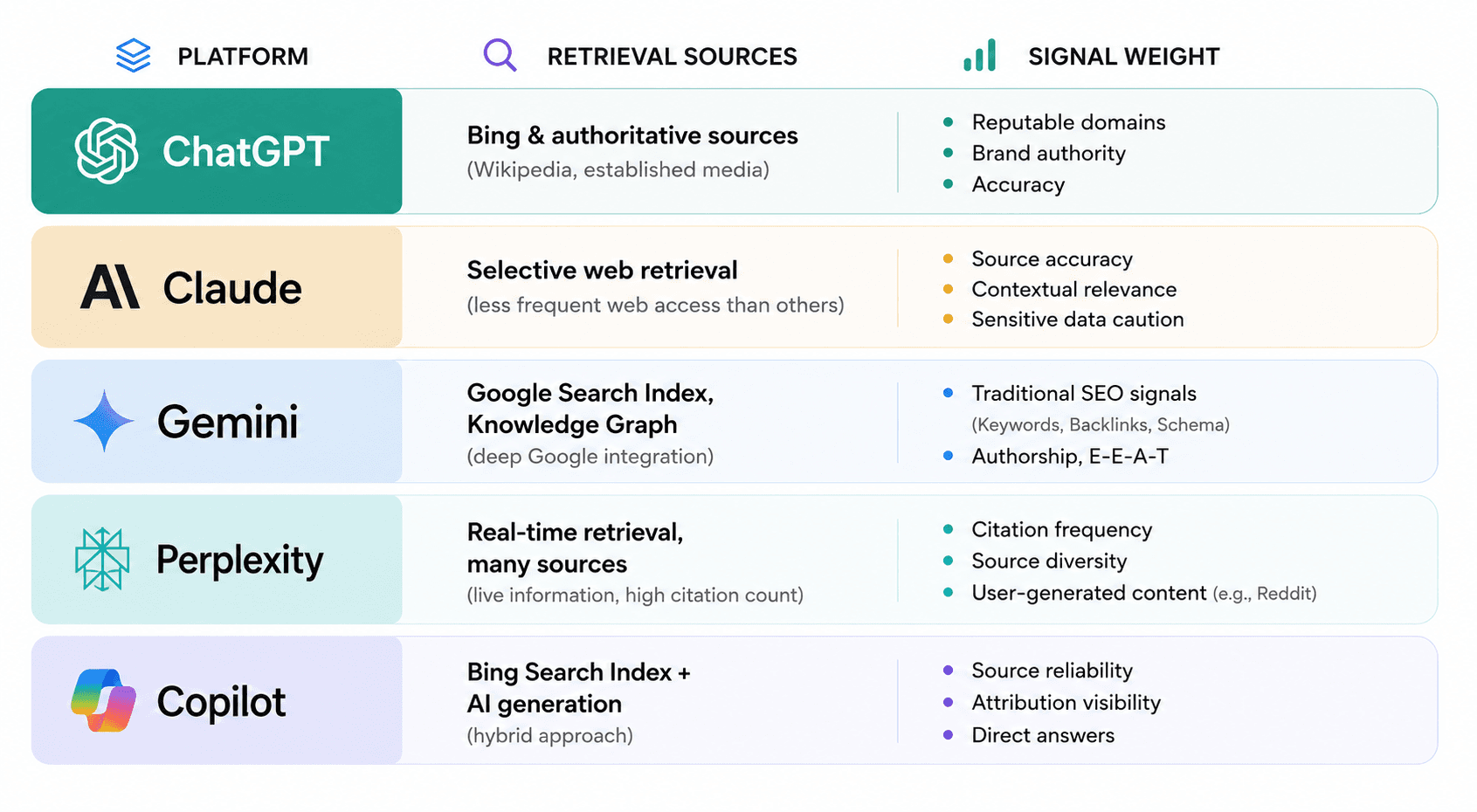
The differences are summarized below.
Platform | Primary Characteristics |
|---|---|
ChatGPT | Primarily retrieves through Bing and favors authoritative sources like Wikipedia and established media; cites fewer sources than Perplexity but draws from a broad domain pool. |
Claude | Uses web retrieval more selectively and cites external sources less consistently than ChatGPT or Perplexity; Anthropic provides limited public detail on its retrieval logic, so it's best monitored through direct testing. |
Gemini | Closely integrated with Google's Search index and Knowledge Graph, meaning traditional SEO signals and structured data carry more weight here than on most other platforms. |
Perplexity | Frequently cites the most sources per response, retrieves closer to real time, and leans more heavily on community platforms like Reddit than most other assistants. |
Copilot | Built on Bing's search index with an AI generation layer. It generally references fewer sources and often highlights the primary cited source prominently within its responses. |
No single AI platform works exactly like another. Each uses different retrieval methods, citation patterns, and ranking signals. If AI visibility is important to your business, monitor and optimize your content across the platforms your audience actually uses, rather than relying on results from just one.
Building Off-Site Authority
On-page optimization is only part of the equation. AI systems also evaluate how your brand is recognized and validated across the web. Strong third-party signals help establish credibility, making your content more likely to be trusted and referenced.
Trusted Citations: AI systems often value mentions from reputable publications more than a large number of low-quality backlinks. A citation from a respected industry source can strengthen your credibility, even if it doesn't include a followed link.
Wikipedia: For many AI platforms, particularly ChatGPT, Wikipedia remains an influential source of entity information. Accurate, well-sourced coverage can improve how AI systems understand and recognize your brand.
Brand Mentions: Not every valuable mention includes a hyperlink. Podcast appearances, interviews, guest contributions, and media coverage help build consistent brand recognition, allowing AI systems to better associate your brand with a specific topic or industry.
Directory Listings: Consistent business information across trusted directories and review platforms reinforces your entity data. Keeping your business name, address, website, and other details consistent helps AI systems verify your identity and understand what your organization does.
E-E-A-T Signals: Experience, Expertise, Authoritativeness, and Trustworthiness remain important indicators of content quality. AI systems look for similar signals, including verified authorship, transparent sourcing, factual accuracy, and a consistent history of publishing reliable information.
Off-site authority is no longer just about SEO. Every credible mention, citation, and trusted reference strengthens your brand's reputation, making it more likely that AI systems will recognize and confidently reference your content.
Step-by-Step Action Plan
Everything above is context. Here's where you actually start, in the order that keeps you from wasting effort on the wrong thing first.
Audit current visibility: Ask ChatGPT, Claude, Gemini, and Perplexity the exact questions your buyers ask, and record which brands get mentioned and which don't. This is your baseline.
Identify priority gaps: Focus on queries with real buying intent where competitors consistently appear and you don't.
Fix technical access first: Confirm robots.txt isn't blocking AI crawlers, check that core content renders without relying on JavaScript, and correct any schema mismatches.
Optimize highest-intent content: Lead each section with a direct answer, add descriptive headers, and break up dense paragraphs.
Build targeted authority: Earn mentions on the publications, directories, and community sites the platforms you care about actually pull from.
Monitor continuously: Rerun your baseline queries at least monthly, since AI answers shift as models update and competitors publish.
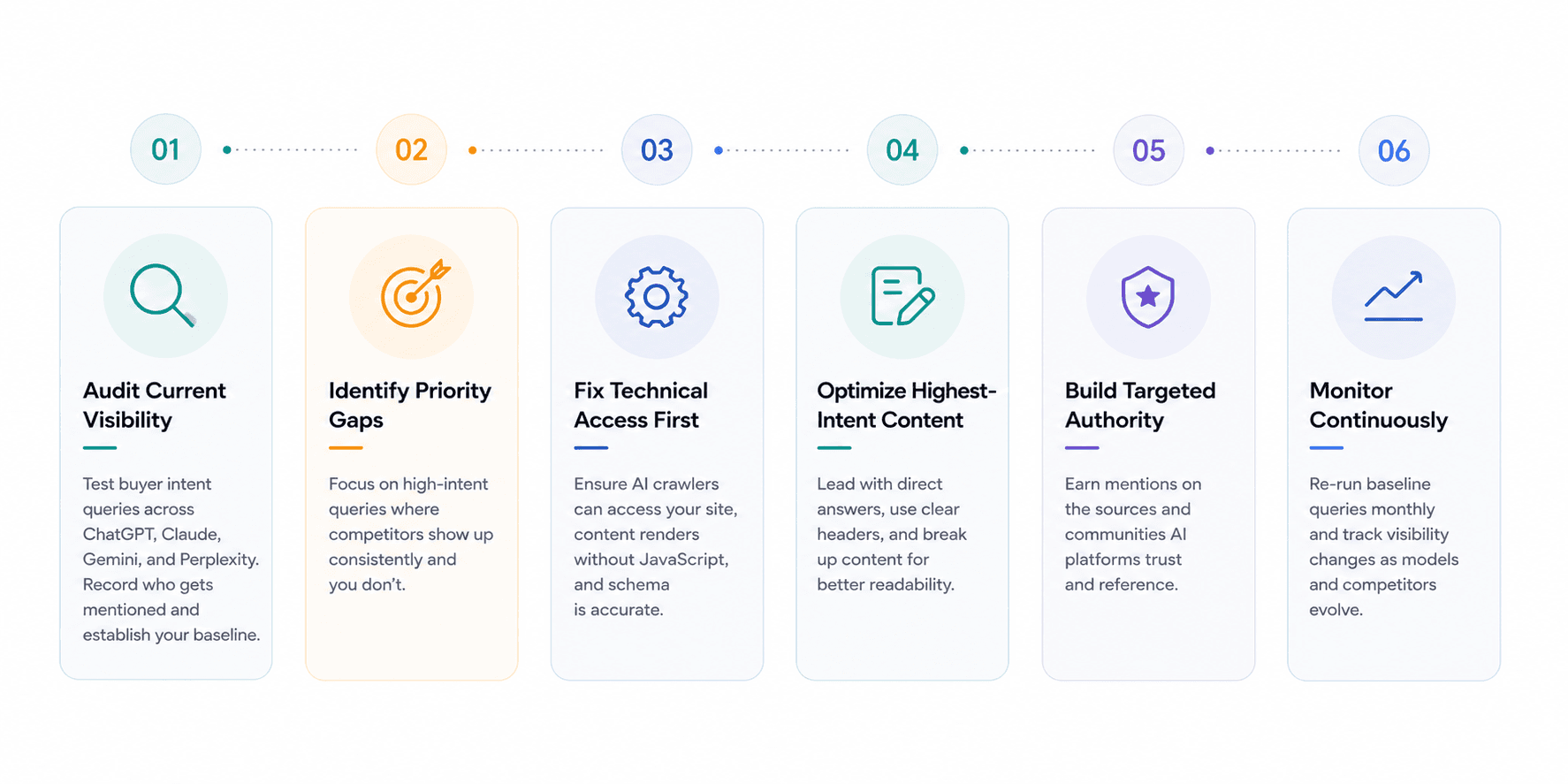
Follow these steps in order. Fix technical barriers before optimizing content, optimize content before building authority, and continuously monitor your results. A structured approach delivers better long-term outcomes than treating each activity as an isolated task.
How to Measure Success
Traditional SEO metrics don't fully capture success in AI search. A brand can influence a customer's decision simply by being cited in an AI generated answer, even if that interaction never results in a website visit. That's why measuring AI visibility requires looking beyond rankings and clicks.
Share of voice: how often your brand appears in AI-generated answers compared to competitors, tracked over time.
Mention sentiment: whether AI systems describe your brand positively, neutrally, or unfavorably, since a mention alone isn't automatically a win.
Crawler activity: server logs showing whether GPTBot, ClaudeBot, and PerplexityBot are actually reaching your pages, which tells you if a gap is technical or content-based.
Referral traffic: sessions from AI platforms in your analytics, understanding this will always undercount true influence since many AI interactions never produce a click at all.
No single metric tells the complete story. Measuring this channel means combining what you can fully control, technical crawler access, with what you can only sample, share of voice and sentiment.
Common Mistakes
Most AI visibility issues don't happen because of poor content. They usually result from a handful of avoidable mistakes that limit how AI systems discover, understand, or trust your content.
Blocking Crawlers: Many websites unintentionally block AI crawlers through outdated robots.txt rules created during previous security or maintenance work. If AI systems can't access your pages, they can't consider them for citations.
Chasing Old Features: FAQ schema still has value for organizing genuine question and answer content, but it should no longer be implemented solely to earn Google's discontinued FAQ rich result. Focus on improving content structure rather than pursuing features that no longer exist.
Focusing on One Platform: Every AI platform retrieves and evaluates information differently. Optimizing only for ChatGPT, Gemini, or any single platform can leave significant visibility opportunities untapped across the others.
Repeating Unverified Statistics: AI Search Optimization is evolving rapidly, and not every widely shared statistic remains accurate over time. Verify the original source and check whether predictions or claims have been validated before using them in your content or strategy.
Measuring Only Clicks: AI search often influences users without generating a website visit. Evaluating success solely through referral traffic overlooks important signals such as AI citations, share of voice, and brand sentiment.
Ranking in AI search isn't a one-time content refresh, it's an ongoing discipline built on crawlable technical infrastructure, clearly structured content, and citations from sources AI systems already trust, measured continuously rather than checked once and forgotten. The sooner you treat AI visibility as its own channel with its own scorecard, the better positioned you'll be as this landscape keeps evolving.
Frequently Asked Questions
How do I actually fix my AI search visibility and start getting organic growth from it?
Start with a free GrowthOS audit, it shows you exactly where your brand is missing from AI answers today, with no commitment attached. From there, you can run the fixes yourself inside the GrowthOS platform, or hand the whole thing to the GrowthOS agency team. Either path works, so pick whichever matches how your team actually operates.
Do I need separate strategies for AEO, GEO, and LLMO?
No. These terms largely describe the same underlying work of making content easy for AI systems to find, trust, and cite. One strategy covers all three labels.
Is the FAQ schema still worth using?
Yes, but not for the reason it used to matter. Google removed the visual FAQ rich result in May 2026, so it no longer earns that SERP feature. It remains a valid markup that helps machines parse genuine Q&A content.
How long does it take to see results from AEO work?
Timelines vary by platform and existing site authority. Technical fixes, like unblocking a crawler, can show effects within weeks, while citation-based authority typically takes several months.
Which AI platform should I prioritize first?
That depends on where your buyers go. ChatGPT has the largest user base by far, Gemini matters most if your audience relies on Google, and Perplexity is worth prioritizing for research-heavy comparison shopping.
Newsletter
Enjoyed this? Get the next one.
SaaS organic growth field notes, straight to your inbox. No spam, unsubscribe anytime.
No spam. Unsubscribe anytime.
Book a demo
See a SaaS growth week
30 minutes. Bring one KPI and your stuck backlog, leave with a written shipping plan, even if you don't hire GrowthOS.