
Your site ranks page one on Google for the keyword that matters most to your business. You've built the backlinks, published the pillar page, and followed every SEO best practice. Then a prospect asks ChatGPT for a recommendation in your category, and your brand never appears. Instead, it recommends a competitor that doesn't even outrank you on Google.
That's not a fluke, and it doesn't mean your content got worse. It means a second, independent ranking system now influences a growing share of buying decisions, and it follows different rules than Google.
This guide breaks down what traditional SEO and GEO actually are, why they diverge more than most people realize, and how to build visibility across both.
TL;DR
Traditional SEO ranks whole pages against each other. GEO competes for inclusion inside one generated answer that may cite several brands, or none, which is a different scoring problem, not just a new channel.
GEO, AEO, and LLMO get used almost interchangeably. They're not identical, but the day to day work overlaps enough that one strategy covers all three.
ChatGPT, Claude, Gemini, and Perplexity each retrieve from different indexes and weigh different signals. Unlike Google's largely deterministic rankings, their answers are probabilistic, so visibility has to be tested across many prompts, not one search.
Some brand mentions come from training data, not live retrieval. No amount of content optimization earns a citation that was never going to be retrieved in the first place.
Getting cited comes down to three fixable things: crawlers that can actually reach your content, passages structured to be extracted on their own, and entity signals (schema, reviews, Wikipedia, Wikidata) that make AI systems trust you enough to name you.
Measuring this needs its own scorecard, share of voice and citation rate, not rank trackers, and the real advantage goes to brands that treat SEO and GEO as one connected system instead of picking one.
What is traditional SEO?
Traditional SEO is the practice of optimizing your website so search engines like Google and Bing can crawl, index, and rank it for relevant queries. The goal is simple: earn a higher position in search results and more organic traffic.
It's built on four core pillars:
Keywords: Matching the terms people actually search for.
Backlinks: Earning links that signal trust and authority.
On-page SEO: Optimizing titles, headers, metadata, and content.
Technical SEO: Improving crawlability, site speed, indexing, and mobile usability.
Google still processes more than 5 trillion searches a year. That scale alone ensures traditional SEO remains essential. It is the foundation that everything else in this guide builds on.
What is GEO?
Generative Engine Optimization is optimizing content and brand presence to get cited or recommended inside AI generated answers, on ChatGPT, Claude, Gemini, Perplexity, and similar systems. You're not competing for a position on a page. You're competing for inclusion inside one synthesized response that might name several brands, or none.
Why this is a structurally different problem:
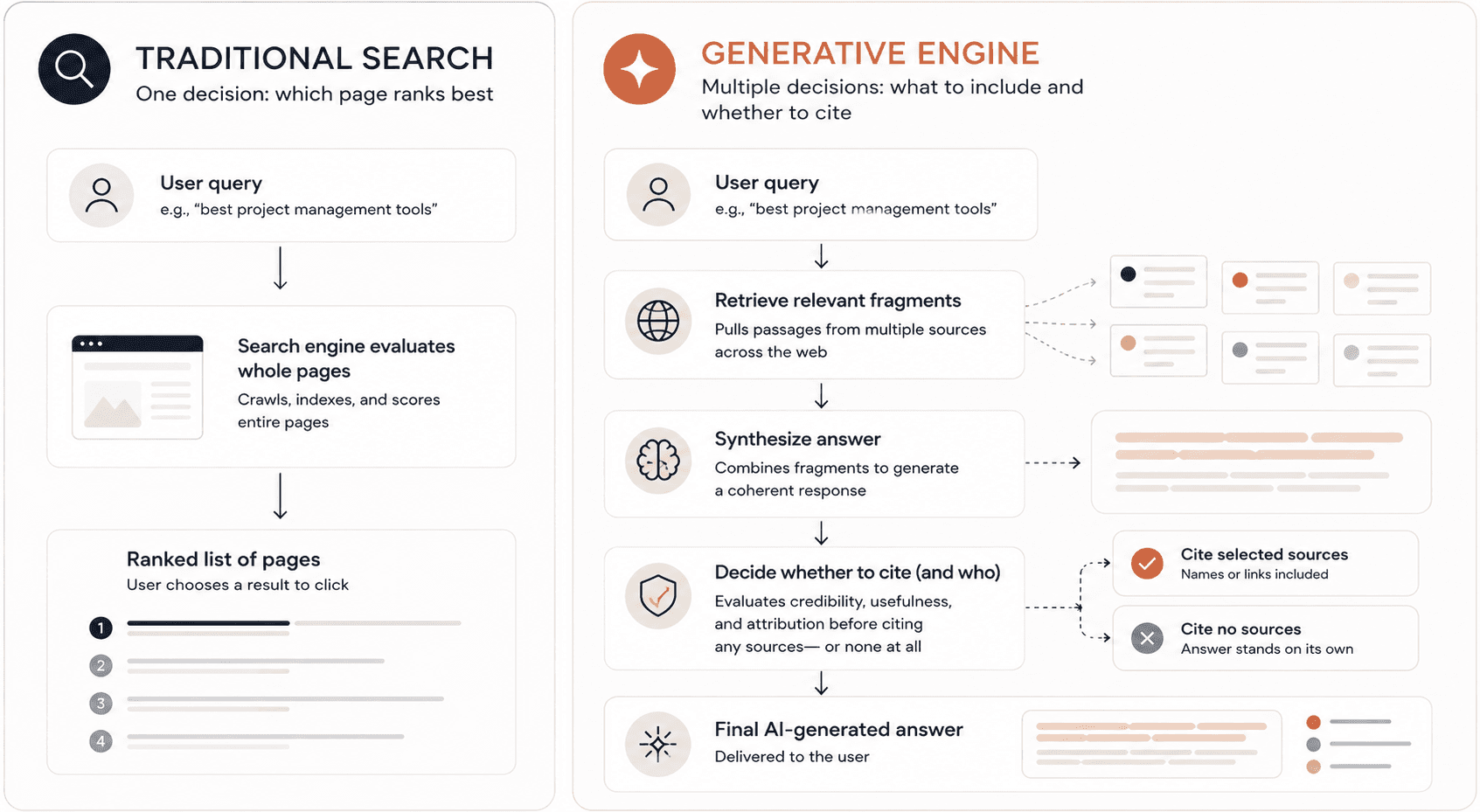
A search engine has one job: decide which whole page deserves which position.
A generative engine has a harder job: decide what the answer is, pull specific passages from multiple sources to support it, then separately decide whether any source is worth naming.
Ranking well used to be the whole game. Now it's one input into a decision the AI mostly makes on its own. A well structured paragraph that directly answers a question can get cited even if the page hosting it would never make Google's first page.
AEO, GEO, or LLMO: Does the Difference Actually Matter?
You'll see GEO, AEO, and LLMO used as if they're the same thing, and functionally, the day to day work often is the same, but each term emphasizes a slightly different perspective.
Term | Framing | Used most by |
|---|---|---|
AEO (Answer Engine Optimization) | Optimizing for answer engine products specifically: ChatGPT, Perplexity, Gemini | SEO practitioners and marketers |
GEO (Generative Engine Optimization) | Optimizing for generative AI systems as a category, not tied to one product | Researchers and technical writers |
LLMO (Large Language Model Optimization) | Optimizing from the model's perspective: retrieval, context selection, semantic matching | AI and ML practitioners |
The difference is emphasis, not strategy. If your content is genuinely structured to be discovered, trusted, and cited by an AI system, you're doing all three at once. There's no separate playbook for each.
How traditional search engines rank pages
Google and Bing both run the same three step pipeline.
Crawl: Bots such as Googlebot and Bingbot discover pages by following links and downloading content. If a page can't be crawled, it can't appear in search.
Index: Crawled pages are processed and stored in a searchable index based on their topics, entities, and content. A page can be crawled but never indexed because of duplicate content, thin value, or an accidental "noindex" tag.
Rank: When someone searches, the search engine scores relevant indexed pages using hundreds of signals, including relevance, backlinks, page quality, site performance, and authority, then orders them accordingly.
The exact weighting of those signals has shifted constantly across two decades of algorithm updates. The model itself hasn't. Whole pages compete against other whole pages for a limited number of rankings, with the expectation that a user will choose one of them.
How AI answer engines actually retrieve content
Most AI answer engines use retrieval augmented generation (RAG). Instead of relying only on what the model learned during training, they retrieve relevant information at query time, rank the best evidence, and use that context to generate a grounded response.
While every platform implements retrieval differently, most production RAG systems follow the same five-step workflow:
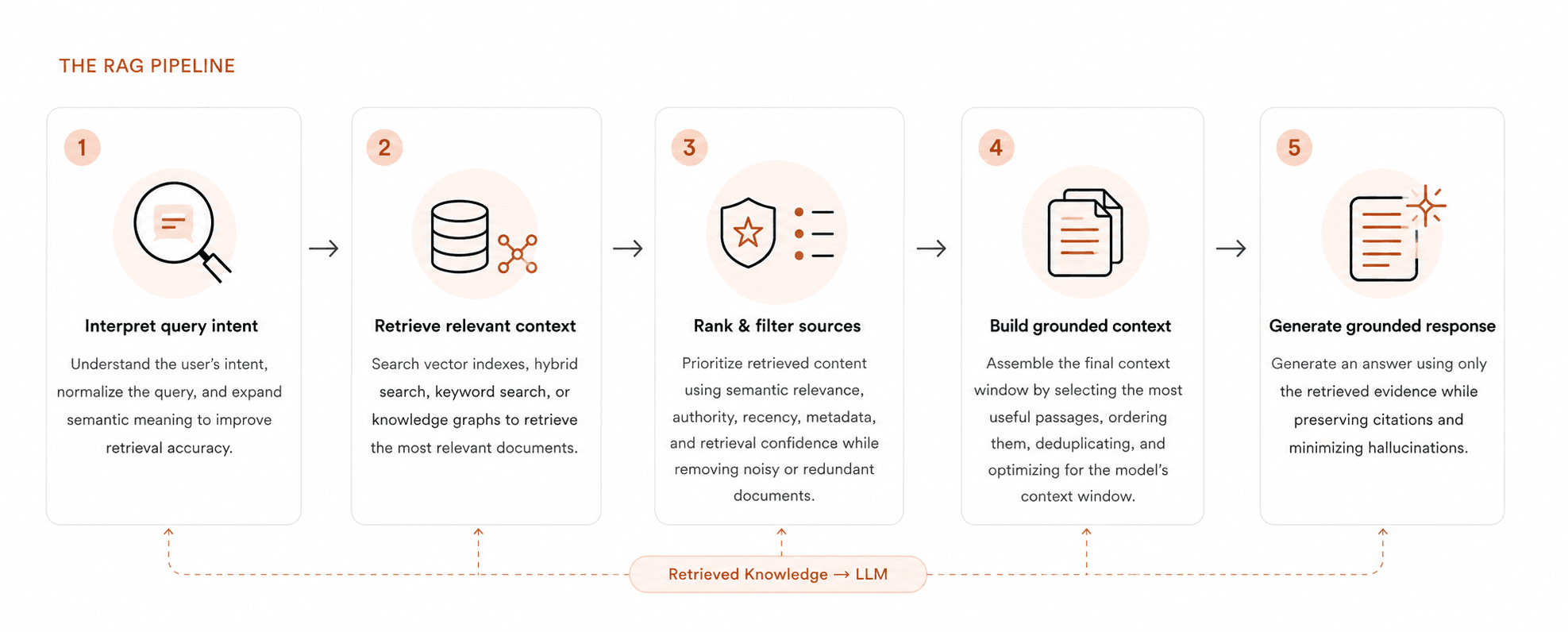
Interpret the query: Understand the user's intent, resolve ambiguity, and prepare the query for retrieval.
Retrieve relevant context: Search vector indexes, hybrid search, keyword search, or knowledge graphs to find the most relevant passages.
Rank & filter sources: Score retrieved content using semantic relevance, authority, freshness, structured formatting, and retrieval confidence before removing weaker results.
Build grounded context: Select and organize the highest-quality passages into an optimized context window for the language model.
Generate a grounded response: Generate an answer using the retrieved evidence, with citations or source references where the platform supports them.
Every AI platform follows this workflow differently. The retrieval systems, ranking signals, and citation behavior vary between ChatGPT, Claude, Gemini, Perplexity, and other AI products, which is why AI visibility can't be optimized for just one platform.
Why Answer Engines Don't Retrieve the Same Way
Every AI platform retrieves information differently. Treating "AI search" as one channel is the most common strategic mistake in this space.
Platform | How it retrieves |
|---|---|
ChatGPT | Primarily relies on Bing's index and tends to favor authoritative sources such as Wikipedia and established publishers. |
Perplexity | Retrieves closer to real time, cites the most sources per answer, leans more on community platforms like Reddit |
Google AI Overviews/Gemini | Deeply integrated with Google's own Search index and Knowledge Graph, so traditional SEO signals and schema carry more weight here than elsewhere |
Claude | Uses web retrieval more selectively, cites external sources less consistently, and Anthropic publishes limited detail on the retrieval logic |
A brand that's visible in ChatGPT may not appear in Perplexity, and vice versa. There isn't a single AI ranking to optimize for, but several retrieval systems with different priorities.
Why the Same Prompt Gets a Different Answer Every Time
Google Search is largely deterministic. The same query from the same location usually produces the same ranked results, making rank tracking possible.
AI answer engines are probabilistic. The same question can produce different brands, explanations, or citations depending on:
The exact prompt
Conversation history
The model version
Normal variation in generation
This is why AI visibility can't be measured with a single search. It has to be evaluated across many prompt variations.
Some Brand Mentions You Can't Influence, and Here's Why
Not every AI generated brand mention comes from live retrieval.
Large language models retain knowledge learned during training, known as parametric memory. When a model answers from parametric memory, it isn't retrieving information from the web. It's recalling patterns encoded during training.
Why this matters:
If your brand became well known after a model's training cutoff, no amount of content optimization today changes what that model already "remembers"
Some brand associations are locked in until the next training run or model update, not the next content refresh
Retrieval based answers can be influenced by what you publish now. Parametric memory based answers largely cannot
This is an important limitation to understand. GEO and AEO can increase the likelihood that your content is retrieved and cited, but they can't overwrite what a model already learned during training. That changes only through future model updates and sustained brand presence across the web.
SEO vs GEO at a glance
Factor | Traditional SEO | GEO/AEO |
|---|---|---|
Goal | Rank on a results page | Get cited inside a generated answer |
Primary signal | Backlinks and keyword relevance | Entity authority, content structure, source trust |
Content format | Long form pages optimized for keywords | Self contained, answer ready passages |
Competitive dynamics | One winner per position | Multiple brands can be cited in the same answer |
Measurement | Rank trackers, Search Console, CTR | Share of voice, citation frequency, sentiment |
Citations vs Backlinks
Backlink | Citation | |
|---|---|---|
Definition | A hyperlink from another site, read by search engines as a vote of trust | An AI platform naming or referencing your brand inside its answer |
URL attached | Always | Not necessarily. Often just your brand name in a sentence |
How value builds | Compounds through link equity passed between pages | Doesn't compound. Evaluated fresh each time an answer is generated |
What carries the most weight | Volume and authority of linking domains | Whether the source is already trusted by the AI platform, like Wikipedia, established media, or high authority industry sites |
Strong backlink profiles still help. They boost the domain authority that makes AI systems more likely to trust and retrieve your content in the first place. But backlinks are an input to citations, not a substitute for them.
How to Structure Content So AI Can Actually Extract It
Structure determines whether an AI system can actually pull your content into an answer, regardless of how good the information is.
Lead with the answer: Start each section with a direct answer. Retrieval systems place significant weight on opening sentences.
Use descriptive headings: Headings that closely match real user questions make sections easier for both readers and AI systems to find.
Define terms clearly: Introduce new concepts with a concise definition near the beginning instead of several paragraphs later.
Keep content scannable: Short paragraphs, bullet points, and numbered steps are easier for both humans and AI systems to parse.
Use tables for comparisons: Tables are often easier to extract than long paragraphs comparing multiple options.
Write meaningful image captions: Descriptive alt text and captions help AI systems interpret visual content.
None of this is about manipulating a system. It's the same principle that has always made content effective: answer the question clearly, early, and in a structure that's easy to understand.
Why you need both
SEO and GEO don't compete. They reinforce each other.
Strong SEO fundamentals, backlinks, domain authority, consistent publishing, make your content more likely to get crawled, indexed, and eventually pulled into AI training data and retrieval systems in the first place. A page that never ranks and never earns links is also a page that's unlikely to build the authority signals AI systems look for.
The relationship also works in reverse. GEO drives branded search back into your traditional funnel. Someone who sees your brand recommended inside a ChatGPT answer often doesn't click through immediately, they instead search your brand name on Google later to verify and learn more. That branded search volume is a traditional SEO signal, and it's one your GEO work generated.
The most effective visibility strategies treat SEO and GEO as one connected system, not separate initiatives.
Common AEO Mistakes, and What to Do Instead
Most AI visibility problems aren't content quality problems. They're caused by a handful of common mistakes.
Bad practice | Why it fails | Good practice instead |
|---|---|---|
Burying the answer deep in the page | AI systems extract passages, not entire pages | Lead every section with the direct answer, then explain |
Keyword stuffing | AI systems prioritize meaning over exact phrase repetition | Write naturally, for the actual question being asked |
Accidentally blocking AI crawlers | Crawlers can't retrieve content they can't access | Explicitly allow the crawlers you want reaching your site |
Chasing deprecated schema features | Outdated features no longer provide their original benefit | Use schema to improve structure and machine readability |
Optimizing for only one platform | Every AI platform retrieves content differently | Test and monitor across every platform your buyers actually use |
Treating one AI mention as proof of success | A single favorable citation can be a fluke of that day's prompt and model version | Track share of voice over time, across many prompt variations |
Technical setup for AI crawlers
Even the best content won't be cited if AI crawlers can't access it. Technical accessibility is the foundation of AI visibility.
What Each AI Crawler Actually Does
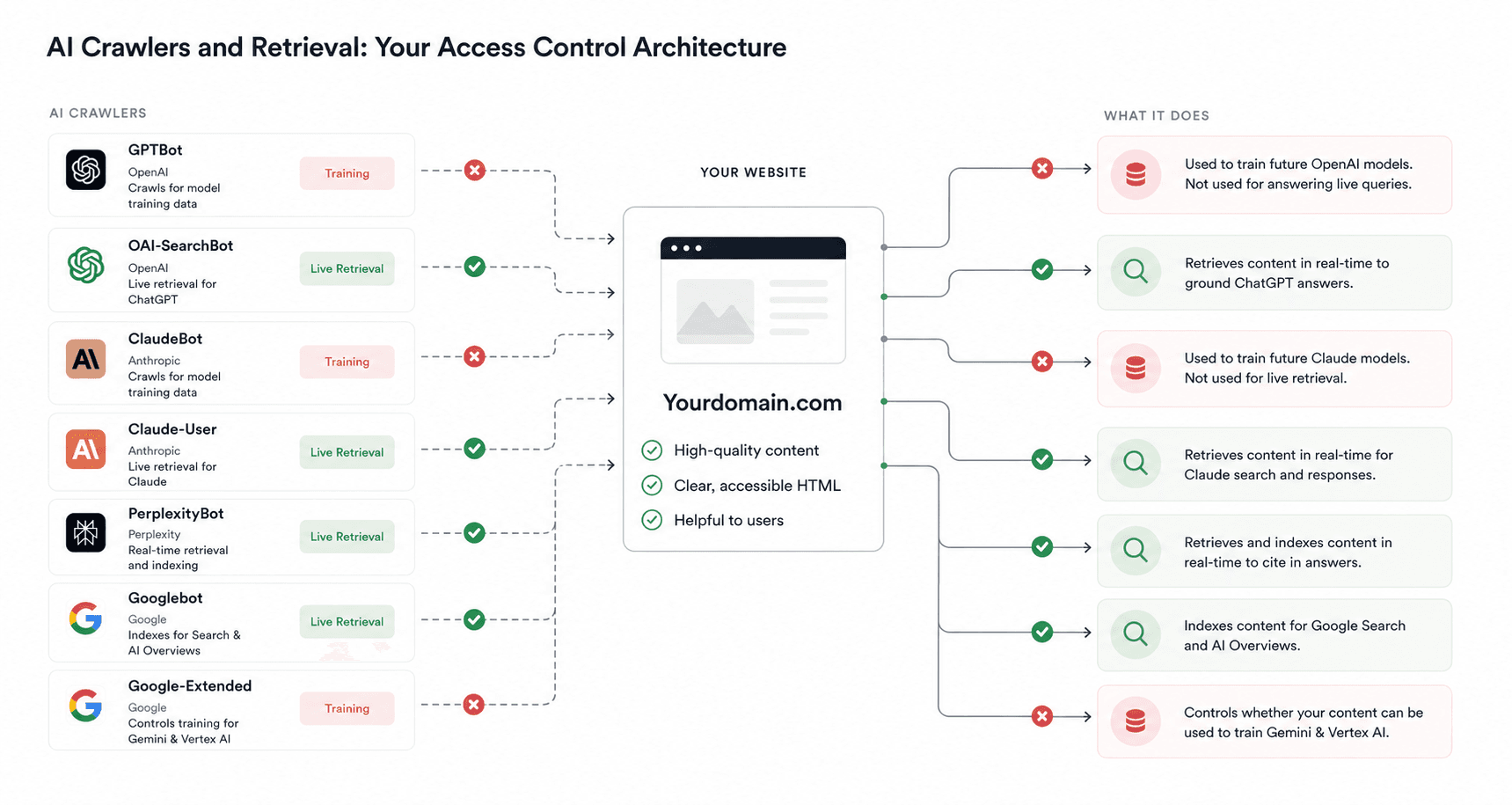
Each AI company runs its own crawler under its own user agent, and most run two types: one that crawls to train future models, and one that retrieves live, in the moment, to answer a specific user question. You can allow one while blocking the other.
A balanced approach is to block training crawlers while allowing live retrieval crawlers.
What each bot actually does:
Company | Bot/User-Agent | Actual Function & Purpose |
|---|---|---|
OpenAI | Crawls web data to train future OpenAI foundation models. | |
OpenAI | Live real-time retrieval to ground ChatGPT user queries. | |
Anthropic | Crawls web data to train future Claude foundation models. | |
Anthropic | Live real-time retrieval for in-chat search features. | |
Perplexity | Real-time web indexer/retriever for citing sources in answers. | |
Indexes pages for Google Search and AI Overviews. | ||
Controls whether content can train Gemini and Vertex AI without affecting AI Overviews. |
A few caveats worth knowing before you ship this:
robots.txt is advisory. Major AI companies generally respect it, but smaller crawlers may not.
Perplexity's crawler behavior remains debated. The company has disputed whether all user triggered retrieval follows the same rules as its autonomous crawler.
Verify crawler access after updating robots.txt. Confirm that the bots you allow can actually fetch your pages.
Avoid relying entirely on client side rendering. Some AI crawlers don't reliably execute JavaScript, making server rendered or static HTML the safer option.
Schema types that matter
Organization schema: Establishes your brand as a distinct entity, separate from the pages that mention it.
Article schema: Marks up author, publish date, and last-updated date, giving AI systems a clear freshness and identity signal to attach to the content.
HowTo schema: Useful for procedural content, though its main value now is helping structure extraction rather than earning a specific rich result.
Product schema: Relevant for comparison and recommendation queries, where AI systems are synthesizing options against specific attributes.
FAQPage schema: Still useful for structuring genuine question-and-answer content, even though Google's FAQ rich result has been retired.
None of this guarantees a citation. What it does is remove the reasons a genuinely strong page might get skipped before an AI system ever gets the chance to evaluate it on merit.
Building Brand Trust Signals AI Systems Actually Check
AI systems don't just evaluate your content. They evaluate whether your brand exists as a recognized, verifiable entity across the web.
sameAs schema: Connects your Organization schema to trusted profiles such as LinkedIn, Crunchbase, your Google Business Profile, and Wikipedia. This helps AI systems recognize the same brand across multiple sources.
Wikidata: A structured knowledge base many AI systems reference for verified entity information. An accurate listing strengthens entity recognition.
Wikipedia: Still an influential source for many AI systems. Earning a page requires independent, reliable coverage and cannot be shortcut through self-published content.
G2 and Capterra in B2B: For B2B software, these platforms provide trusted third-party validation. Reviews and citations here often carry more weight than brand-owned comparison pages.
The common thread isn't ranking manipulation. It's about existing, consistently and verifiably, as a real entity across sources that AI systems already trust.
How to measure success
Traditional SEO metrics, rankings, clicks, impressions, don't capture what's happening in AI search at all. You need a separate scorecard.
Metric | What it tells you |
|---|---|
Brand mention rate | How often your brand comes up at all across a set of relevant prompts |
Citation rate | How often that mention comes with an actual named source or link |
Share of voice | How your mention frequency compares to competitors, tracked over time |
Sentiment | Whether the AI describes your brand positively, neutrally, or unfavorably. A mention is not automatically a win |
Prompt coverage | How many of the actual questions your buyers ask return your brand at all |
Why AI share of voice is a sample, not a census
Traditional rank tracking checks a real, fixed position that genuinely exists at that moment. AI share of voice measures how often your brand appears across a representative set of prompts.
That means:
Your actual share of voice number is an estimate built from a sample of prompts, not a full accounting of every possible question a buyer could ask
Results can shift between runs simply because AI answers are probabilistic, not because anything about your site changed
A tool's reported number is only as good as its prompt set. Different tools, testing different prompts, will report different numbers for the same brand, and neither is "wrong"
The practical takeaway: Use AI share of voice to track directional trends over time, not as an exact metric across different tools or a single snapshot of performance.
Why AI Visibility ROI Is Harder to Prove Than SEO ROI
Proving ROI on AI visibility is genuinely harder than proving ROI on SEO, because most AI interactions never produce a click at all.
Three approaches that hold up:
Branded search lift: When an AI system recommends your brand by name, people often go search for you directly on Google right after. A rise in branded search volume that correlates with a rise in your AI citation rate is a real, measurable signal, even without a direct click.
Pipeline correlation: Track whether leads or customers who mention discovering you "through ChatGPT" or similar, via a form field or sales conversation, correlate with periods of stronger AI visibility.
Holdout testing: Where feasible, compare performance across regions or segments where you've done AI optimization work against ones where you haven't, similar to a geo holdout test in traditional marketing.
None of these are as clean as a last click attribution report. Be honest about that with stakeholders rather than presenting a manufactured number as more precise than it is.
AI visibility monitoring tools compared
Tool | Best for | Starting price | Notable strength |
|---|---|---|---|
Brands and agencies needing full monitoring + optimization | 15+ (ChatGPT, Claude, Gemini, Perplexity, Copilot, and more) | Real-time monitoring, competitor benchmarking, citation source mapping, AI crawler analytics, prioritized content recommendations | |
Semrush AI Toolkit | Teams already in the Semrush ecosystem | ChatGPT, Google AI Overviews, AI Mode | AI visibility score; integrated with traditional SEO data |
Peec AI | Global brands needing multi-language tracking | ChatGPT, Perplexity, Claude, Gemini | Daily citation and sentiment tracking; strong regional breakdown |
Otterly AI | Budget-conscious teams and agencies | ChatGPT, AI Overviews, Perplexity, Gemini, Copilot | GEO audit + monitoring starting free; Gartner Cool Vendor recognition |
Profound | Enterprise brands at scale | 10+ platforms including ChatGPT Shopping | Prompt volume data; deep enterprise analytics |
GrowthOS's Free AI Visibility Report takes less than a minute and shows your visibility across ChatGPT, Claude, and Gemini, highlights competitors outranking you, and prioritizes the highest-impact improvements, no credit card required.
When to prioritize SEO vs GEO
Neither discipline replaces the other, but budget and attention are finite, and where you lean first depends on a few honest questions about your business.
Prioritize SEO if:
Your category has high search volume and established commercial keywords.
Most buyers still begin with Google.
You're still building domain authority.
Prioritize GEO if:
Competitors already appear in AI answers while you don't.
Prospects mention discovering competitors through ChatGPT or similar tools.
Your buyers rely heavily on AI for research.
Invest in both if:
You have the resources to do so. SEO strengthens GEO, and GEO creates demand that feeds back into SEO. Most established B2B SaaS companies eventually benefit from treating them as one strategy.
The wrong move is treating this as permanent triage. Revisit the split quarterly. A category with low AI query volume today can shift fast, and the cost of starting GEO work late is losing ground to a competitor who didn't wait.
The 7-Step Action Plan to Build AI Search Visibility
Audit current visibility: Test the questions your buyers ask in ChatGPT, Claude, Gemini, and Perplexity. Record which brands appear.
Identify priority gaps: Focus on high-intent queries where competitors consistently outperform you.
Fix technical access: Ensure AI crawlers can reach your content and verify rendering and schema.
Optimize priority pages: Lead with direct answers, improve headings, and make content easier to extract.
Build off-site authority: Earn mentions on trusted publications, directories, and communities your target AI platforms reference.
Strengthen entity infrastructure: Implement sameAs schema, maintain consistent business profiles, and build trusted entity signals.
Monitor continuously: Recheck your baseline prompts every month and adapt as models and competitors evolve.
Follow the order. Fixing technical access before optimizing content, and optimizing content before chasing authority, prevents wasted effort on work that can't pay off until the step before it is actually done.
Frequently Asked Questions
What's the fastest way to actually fix this and start seeing organic growth?
Start with a free GrowthOS audit to see exactly where your brand is missing from AI search results. From there, either implement the recommendations yourself using the GrowthOS platform or let the GrowthOS agency team handle everything for you. Both paths are designed to improve your visibility across AI search and traditional search.
Why does my brand rank first on Google but never get mentioned by ChatGPT?
Because Google and ChatGPT evaluate content differently. Google ranks entire pages for specific positions, while ChatGPT retrieves and synthesizes information from multiple sources before deciding whether to cite a brand. Ranking well on Google doesn't automatically guarantee AI visibility.
Is blocking AI crawlers a smart way to protect our content?
Usually not. Blocking training crawlers like GPTBot can protect your content, but blocking search-time crawlers can prevent your brand from being cited. Most businesses should block training bots selectively, not all AI crawlers.
How long before we see results from AEO work?
Technical fixes, like unblocking a crawler, can show effects within weeks. Citation based authority, earned through entity infrastructure and third party validation, typically takes several months to build.
Which AI platform should we prioritize first?
Whichever one your actual buyers use most. For most businesses, that's ChatGPT, followed by Gemini and Perplexity based on your audience and industry.
Newsletter
Enjoyed this? Get the next one.
SaaS organic growth field notes, straight to your inbox. No spam, unsubscribe anytime.
No spam. Unsubscribe anytime.
Book a demo
See a SaaS growth week
30 minutes. Bring one KPI and your stuck backlog, leave with a written shipping plan, even if you don't hire GrowthOS.