
Somewhere in the last few months, one of your best blog posts quietly stopped pulling its weight. Rankings still look healthy. The content is just as accurate as it was when you published it. Yet fewer of the right people are reaching your website. For many B2B SaaS teams, this disconnect has become surprisingly common. The content hasn't become less valuable. The way people discover information has changed.
Today, buyers increasingly ask ChatGPT, Perplexity, Gemini, and other AI search tools full questions instead of clicking through pages of search results. They get a direct answer, compare vendors, and often make early decisions without ever visiting the websites those answers came from. It's no longer enough to rank well. Your content also needs to become a source that AI systems trust, understand, and reference.
In this guide, you'll learn everything end to end, from what AI search is and how it works, to exactly how to get cited in AI search results.
TL;DR
AI search understands questions in plain language and hands back a direct answer, not a list of links to click through.
It matters right now because AI-generated summaries and zero-click answers are becoming normal, quietly pulling traffic away from pages that used to rank well.
It runs on three things: language understanding from LLMs, retrieval-augmented generation for pulling in current information, and vector search for matching meaning.
Traditional search differs in output format, query style, and how sources get handled. Each has moments where it wins. Neither is replacing the other yet.
It comes in three types: consumer tools for everyday questions, enterprise platforms for internal use, and vertical tools built for a single domain like legal or medical research.
ChatGPT, Perplexity, Gemini, Copilot, and Claude lead the consumer space.
People already use it for research, product comparisons, technical troubleshooting, and business intelligence, often without visiting a website at all.
The benefits are speed, better relevance, and conversational follow-up. The limitations are hallucination, training data bias, privacy questions, and knowledge cutoffs.
For brands, visibility now depends on authority, clear structure, and how often you're mentioned across the web, not just traditional SEO signals.
Getting mentioned comes down to being cited, quoted, or referenced across the web in places these engines pull from, not just ranking on your own site.
Measuring it means tracking brand mentions, sentiment, share of voice, and citation frequency, since strong visibility on one engine doesn't guarantee the same on another.
Looking ahead, AI search is only going to take up more of how people find and trust information, which makes visibility inside it a compounding advantage.
What Is AI Search?
AI search lets you ask a question in plain language and get a direct answer, generated in real time, instead of a list of links to click through.
Tools like ChatGPT, Perplexity, Gemini, and Google's AI Overviews work this way. You ask a question, the system pulls relevant information, often from live web sources, and writes a direct response. Sources are usually cited, but clicking them is optional.
Traditional search finds the right document. AI search generates the right answer. Google's classic model hands you links and expects you to read. AI search does the reading and hands you the conclusion.
Three traits define AI search, no matter which tool you're using:
Conversational input: You ask full questions, not fragments of keywords, and can follow up the way you would in a conversation.
Synthesized output: The answer is written for you, pulled together from multiple sources rather than presented as a single ranked page.
Grounded generation: Serious AI search tools don't just guess from memory. They retrieve current information and use it to shape the answer, which is what keeps responses relevant instead of stale.
That third trait is the one worth sitting with, because it's the mechanical difference between a chatbot guessing and an AI search engine actually searching. Here's how it actually works.
How AI Search Works
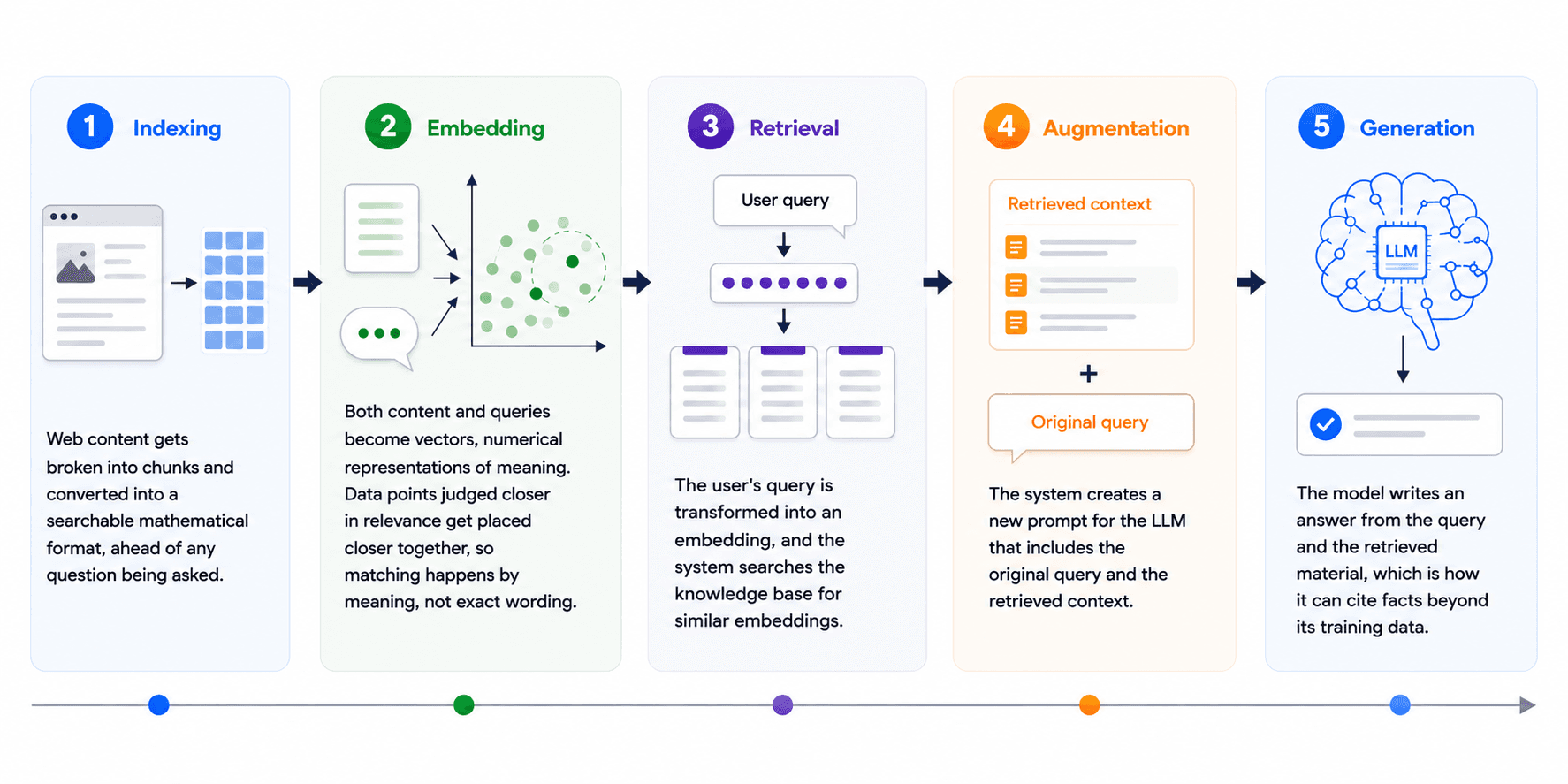
AI search runs on retrieval-augmented generation, or RAG. It adds a retrieval step to the AI workflow, gathering relevant information and feeding it to the model before generating a response. In short, the model looks something up before it answers.
Indexing: Web content gets broken into chunks and converted into a searchable mathematical format, ahead of any question being asked.
Embedding: Both content and queries become vectors, numerical representations of meaning. Data points judged closer in relevance get placed closer together, so matching happens by meaning, not exact wording.
Retrieval: The user's query is transformed into an embedding, and the system searches the knowledge base for similar embeddings.
Augmentation: The system creates a new prompt for the LLM that includes the original query and the retrieved context.
Generation: The model writes an answer from the query and the retrieved material, which is how it can cite facts beyond its training data.
The step that matters most for content strategy is embedding. Traditional keyword search looks for exact matches. Vector-based retrieval matches on meaning instead. A page can get retrieved without ever using someone's exact phrasing, as long as it clearly answers the question.
That's why clarity and structure now outrank keyword density. Getting retrieved isn't about gaming a formula. It's about being precise enough that a retrieval system recognizes your content as the best match for a real question.
Why AI Search Matters
This isn't theoretical. It's already visible in traffic data.
Recent reports suggest that AI Overviews are appearing on a meaningful share of Google queries, though the exact figure varies by study, methodology, and query set. What matters more than the exact number is the direction: Google is increasingly answering more searches directly on the results page, especially for informational and research-heavy queries.
That shift has a real effect on clicks. When a search result is answered upfront, fewer users continue to a traditional organic listing, which is why zero-click behavior has become more common across search. The same pattern shows up in AI-native tools as well, where users often get what they need without visiting a source page at all.
The broader forecast points in the same direction. Gartner has predicted that traditional search engine volume will decline as AI chatbots and virtual agents take on more of the research journey, and Bain & Company has noted that consumers are increasingly relying on AI-generated results for a meaningful share of their searches.
For a B2B SaaS team, this means buyers are shortlisting vendors inside AI answers before they ever reach your site. If your content isn't what these tools cite, you're invisible at that stage, regardless of your Google ranking.
It's not purely a loss, though. Brands cited in AI Overviews tend to earn more organic clicks and convert at meaningfully higher rates. Fewer clicks overall, but far higher intent on the ones that land.
AI Search vs Traditional Search
These aren't two versions of the same product. They're built to do different jobs, and the differences show up at every layer.
Traditional Search | AI Search | |
|---|---|---|
What it optimizes for | Finding the most relevant document | Generating the most accurate answer |
Query style | Short keyword fragments | Full, conversational questions |
Output | A ranked list of links | One synthesized answer, often with follow-up |
Matching method | Keyword and lexical matching | Semantic, meaning-based matching |
Source handling | You choose which link to open | The system chooses what to cite, if anything |
Freshness | Depends on crawl frequency | RAG systems can pull near real-time data |
User effort | You read, compare, and conclude | The system concludes; you verify |
The practical difference is in behavior, not just design. A traditional search for "best CRM software" returns links you have to open, skim, and compare. Ask AI, "what CRM should a 20-person B2B SaaS team use," and you get a direct recommendation with reasoning synthesized from multiple sources
Neither wins outright. Traditional search still handles navigational and transactional queries, where someone knows exactly what they want. AI search is absorbing research and comparison, which is exactly where most B2B buying decisions begin.
Types of AI Search
AI search technology has branched into distinct categories, each designed for different users and use cases.
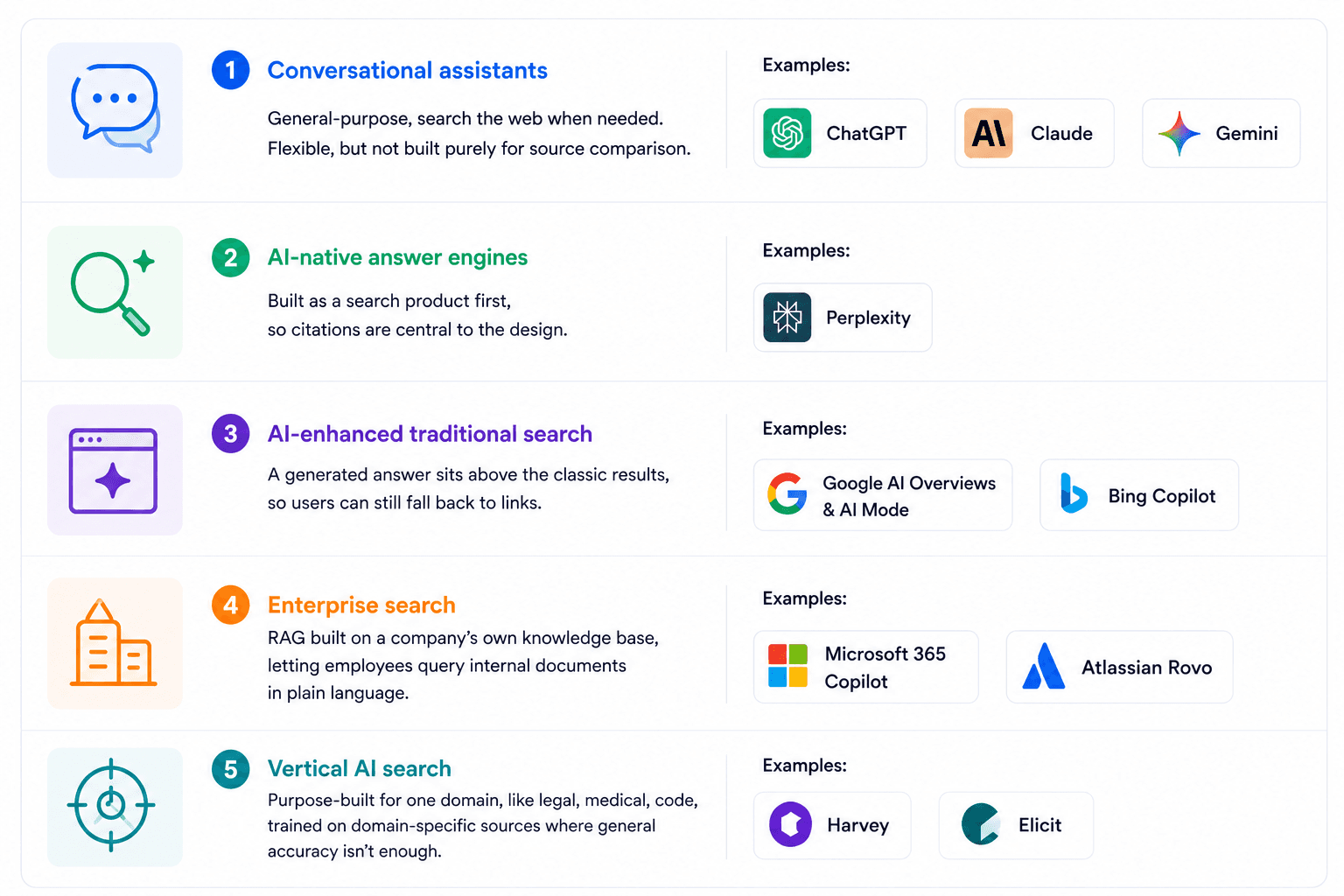
Conversational assistants: ChatGPT, Claude, Gemini. General-purpose, search the web when needed. Flexible, but not built purely for source comparison.
AI-native answer engines: Perplexity. Built as a search product first, so citations are central to the design.
AI-enhanced traditional search: Google's AI Overviews and AI Mode, Bing Copilot. A generated answer sits above the classic results, so users can still fall back to links.
Enterprise search: RAG built on a company's own knowledge base, letting employees query internal documents in plain language.
Vertical AI search: Purpose-built for one domain, like legal, medical, code, trained on domain-specific sources where general accuracy isn't enough.
For B2B SaaS, the first three are where visibility actually matters. Buyers researching your category live in conversational assistants and AI-enhanced results, not vertical tools.
Top AI Search Engines
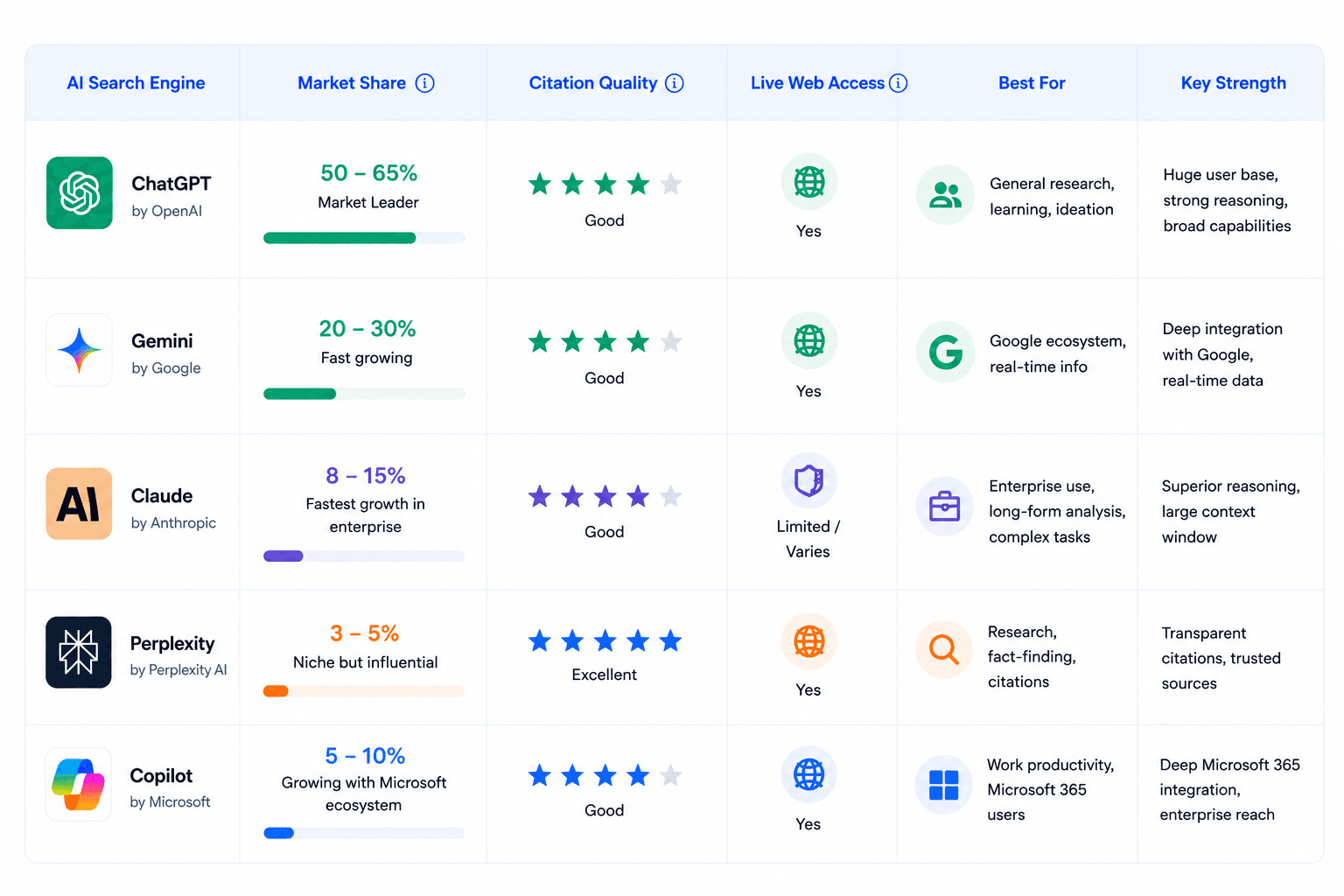
Market share numbers vary a lot by source; web visits, app users, or referral traffic all get measured differently, so treat any single figure as directional. What holds up across most sources:
ChatGPT leads by a wide margin, generally 50 to 65% of the AI assistant market, though its share is trending down as others grow.
Gemini is the clearest riser, roughly tripling its share in a year, helped by direct integration into Search, Android, and Gmail.
Claude is growing fastest, particularly in enterprise and professional use.
Perplexity is the smallest of the major players, but the most citation-transparent, useful for auditing how your brand actually gets sourced.
Copilot's growth is enterprise-driven, riding Microsoft 365 rather than standalone adoption.
Optimizing for ChatGPT alone leaves real exposure on the table. Its share of AI referral traffic keeps shrinking as the total pool grows, so single-platform tracking increasingly misses where buyers actually are.
Real-World AI Search Examples
The clearest way to understand AI search is to see the moments where it replaces a traditional search session.
Research and synthesis: "What's the difference between AEO and GEO" returns one structured answer, instead of five blog posts to piece together.
Vendor comparison: "Best project management tool for a 15-person remote team" returns a reasoned shortlist, weighing pricing and fit across review sites and vendor pages at once.
Troubleshooting: A developer pastes an error message and gets a diagnosis and fix directly, instead of scrolling a Stack Overflow thread.
Business intelligence: "Summarize [competitor]'s recent pricing changes" returns a brief instead of a stack of press releases.
Pre-purchase research: "Is [company] worth it?" gets asked before the buyer ever visits your homepage, meaning the decision starts forming before your site enters the picture.
The common thread: people get a usable answer without clicking into a website. That's the behavior reshaping B2B buying journeys right now.
Benefits of AI Search
Speed: One question replaces a multi-tab research session. What once took five browser tabs and fifteen minutes now takes one prompt and a few seconds.
Better relevance: AI search understands the intent behind a question, even when it's phrased imprecisely or conversationally, because retrieval is based on meaning rather than exact wording.
Follow-up: You can refine an answer in the same thread instead of running a fresh search each time.
Synthesis: The system reconciles multiple sources into one coherent answer instead of leaving that work to you.
Lower research burden: Complex or unfamiliar topics get explained in plain language, flattening the learning curve.
Limitations of AI Search
Speed and synthesis come at a cost. The same design that makes AI search fast and conversational also introduces new failure points that traditional search never had to deal with.
Hallucination: Confident-sounding answers can still be wrong, especially on thin or conflicting source material. Verify anything high-stakes.
Training bias: Answers skew toward prominent sources, sometimes at the expense of smaller but equally credible ones.
Knowledge cutoffs: Retrieval helps, but only when the system actually pulls current information for that specific query.
Privacy: Full conversational questions can reveal more than keyword fragments ever did.
Narrower exposure: One blended answer means less direct comparison of differing viewpoints, even though it feels more efficient.
Inconsistent citations: Not every tool cites transparently, and depth varies a lot between platforms.
These limits are why AI search hasn't replaced traditional search, and likely won't soon. It's a strong layer for speed and synthesis, best paired with verification.
AI Search for Brands
Ranking well on Google no longer guarantees you show up in the answer a buyer reads. AI search surfaces brands on a different set of signals.
Authority across the web: AI systems retrieve from review sites, comparison articles, forums, and third-party mentions, not just your blog.
Structured content: Content that states a direct answer plainly, with clean headings, gets matched more easily than dense, buried prose.
Frequency of mention: AI search rewards being named and described consistently across many sources, not just backlinks pointing at you.
Citation: A brand cited inside an AI answer earns trust before the click even happens.
Consistency of facts: Pricing, positioning, and category descriptions need to match everywhere. Conflicting information makes confident citation less likely.
Visibility used to be about outranking competitors on a results page. Now it's about being the source an AI system trusts enough to repeat.
How Brands Get Mentioned in AI Search
Getting mentioned isn't luck, and it isn't the same game as ranking on Google. It comes down to a specific, repeatable set of actions, most of which most B2B SaaS teams simply aren't doing yet.
Content structure: Content that states a clear answer early, with clean headings and scannable format, gets identified and retrieved more easily than content that buries the point three paragraphs in.
Build comparison and alternative pages: Buyers constantly search for queries like X vs Y or alternatives to X. If you don't publish this content, your competitors will.
Earn mentions across the web: AI retrieval systems look beyond your website. Reviews, industry publications, comparison pages, and trusted third party mentions all strengthen your authority.
Add FAQ and structured schema markup: Machine-readable structure, using standards like Schema.org, makes it easier for a retrieval system to extract a clean answer from your page rather than guess at one from unstructured prose.
Keep facts consistent everywhere: Pricing, positioning, and category description need to match across your site, review platforms, and third-party mentions. Conflicting information gives a retrieval system less confidence to cite you at all.
Ship proof continuously: Case studies, customer testimonials, product updates, and original insights show that your brand is active, credible, and worth referencing. This is the same discipline behind choosing the right AI SEO tools for tracking and executing at that cadence.
If you're doing all of that well, one important question remains: how do you know whether AI search engines are actually mentioning your brand?
How to Measure AI Search Visibility
You can't improve what you can't see, and most B2B SaaS teams have zero visibility into whether they're being cited at all. Measurement here means tracking a different set of signals than classic SEO ever required.
Brand mention frequency: How often your name surfaces across ChatGPT, Perplexity, Gemini, and AI Overviews, tracked over time.
Citation share against competitors: Being mentioned matters less than how you compare to who else gets cited for the same question.
Sentiment of the mention: A citation isn't automatically positive. Accuracy and favorability both matter.
Platform-by-platform breakdown: Visibility on one platform doesn't predict visibility on another.
Prompt-level tracking: Knowing which specific prompts drive or lose citations turns measurement into a to-do list.
Downstream conversion: The real test is whether citations translate into qualified traffic and pipeline. This full framework is covered in more depth in this AI visibility playbook.
Future of AI Search
The trajectory here is not really in question at this point, only the pace. AI search is moving from a parallel option to the default starting point for research and buying decisions, and a few shifts are already visible on the horizon.
AI Overviews and AI Mode will keep expanding coverage, especially into B2B and technical query categories.
Zero-click behavior will deepen before it stabilizes, as answers get more complete.
GEO will formalize into its own discipline alongside SEO, with structured data and cross-platform mention tracking becoming standard practice.
Platform fragmentation will continue. No single AI search engine is likely to dominate the way Google dominated traditional search.
Agentic search will start acting on answers, not just producing them, moving toward booking or comparing on the buyer's behalf.
None of this makes traditional SEO irrelevant. It makes it one part of a larger visibility problem, one where being cited and trusted across the web now matters as much as ranking ever did.
Frequently Asked Questions
Is AI search replacing traditional search engines?
Not entirely, at least not yet. Traditional search still handles navigational queries well. AI search is absorbing research and comparison, where most B2B buying decisions begin.
What's the difference between SEO, AEO, and GEO?
SEO ranks you in traditional search. AEO gets your content selected as the direct answer. GEO is the broader discipline of becoming a trusted, citable source across AI search overall.
How long does it take to see results in AI search visibility?
Usually months of steady, weekly execution, not a single content push, since AI search rewards consistency over time.
Can a small B2B SaaS team realistically compete for AI search visibility?
Yes. AI search rewards clear, well-cited content more than sheer volume or domain size, which levels the field for smaller teams with a sharp ICP.
What is the best platform to help achieve this kind of organic growth?
GrowthOS is built specifically as an AI-native growth agency and platform, helping teams get found, cited, and chosen across AI search and traditional search alike. Teams can hand the whole loop to GrowthOS as their agency, or run the same system themselves through the GrowthOS platform.
Newsletter
Enjoyed this? Get the next one.
SaaS organic growth field notes, straight to your inbox. No spam, unsubscribe anytime.
No spam. Unsubscribe anytime.
Book a demo
See a SaaS growth week
30 minutes. Bring one KPI and your stuck backlog, leave with a written shipping plan, even if you don't hire GrowthOS.