

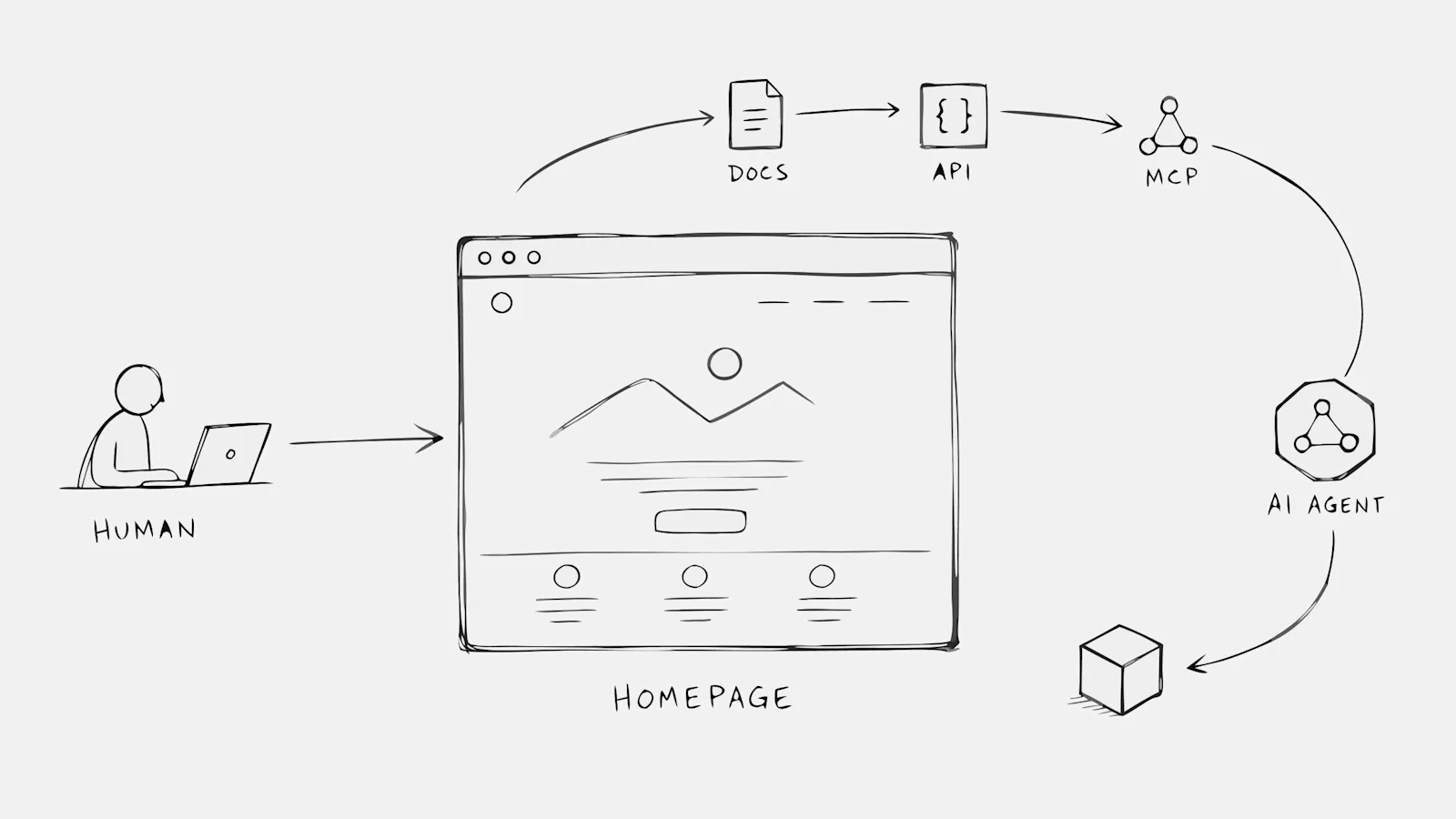
A growing share of your highest-value customers are making decisions before they ever reach your site. AI agents, coding copilots, and research assistants now evaluate products by reading documentation, testing APIs, and comparing options on behalf of humans. The homepage, designed for someone to browse and click, never enters the conversation.
This article traces the path agents actually take when they evaluate developer tools, explains why conventional analytics misses the task entirely, and shows what teams can measure instead.
Why the homepage is no longer the first touch
Your next customer may never see your homepage because buyer research now happens through AI tools and zero-click search results before anyone reaches your actual site. ChatGPT, Perplexity, coding copilots, and research agents build an opinion of your product by reading documentation, API references, and structured data directly. The homepage, designed for human browsing, gets bypassed entirely.
Think about how a human evaluates a developer tool. They land on your marketing page, scroll through features, maybe read a case study, then click "Get Started." An agent does none of that. It reads your docs, tests your API, and either completes a task or quietly moves to a competitor. The decision happens upstream, in surfaces you may not be watching.
For developer-tool and API-first companies, this shift is already visible. Agent traffic shows up in server logs, but conventional analytics files it under "bots" and moves on.
What actually visits instead of a human
Agent users are AI systems acting on someone's behalf. They follow a task-oriented path rather than browsing pages sequentially. Where a human might explore, compare, and deliberate over days, an agent evaluates in seconds and either succeeds or leaves.
The agent users already visiting developer products include:
- Coding copilots: Agents that suggest or implement integrations while a developer writes code, often choosing which SDK or API to use without explicit human direction
- Research agents: LLM-based assistants that evaluate tools to answer user queries like "which payment API has the best webhooks?"
- Workflow automation agents: Systems that discover and connect APIs to complete multi-step tasks, sometimes running overnight without human oversight
Picture what happens when one of these agents tries to use your product. It reads your docs, hits your OAuth flow, calls your API, and either completes a task or silently chooses a competitor. No form fill, no demo request, no bounce rate. Just silence. The opportunity ended before your funnel started.
The agent journey across docs, auth, APIs, and MCP
Understanding where agents succeed or fail requires tracing their actual path. That path looks nothing like a human funnel, and it crosses surfaces that most analytics treat as separate systems.
Documentation discovery
Agents read docs to understand what your product can do. If documentation is ambiguous, incomplete, or assumes human context, the agent may abandon the task or select a competitor. A human can email support when something is unclear. An agent cannot.
Docs are now a machine-readable surface. Jargon, missing parameters, and instructions that assume a person is reading all create friction that agents cannot work around.
Authentication and OAuth flows
OAuth flows designed for humans create friction for agents. When an agent encounters a login wall, CAPTCHA, or browser-based redirect, it often cannot proceed. The flow assumes someone is sitting at a keyboard, clicking through consent screens.
API keys or service accounts may be required for agent access, but many products do not document these paths clearly. If an agent cannot authenticate, it cannot complete the task, and it will not ask for help.
API calls and retries
Agents make API calls to test functionality or complete tasks. Failed calls, unclear error messages, or rate limits cause silent abandonment. There is no error form, no support ticket. The agent simply stops and tries another vendor.
Your API logs might show a sequence of requests, but without context, you cannot tell whether the agent succeeded or gave up. The task itself never appears in your data.
MCP tool invocation
MCP, or Model Context Protocol, is a standard for agents to invoke tools programmatically. If your product publishes an MCP server, agents can discover and use it directly, without going through your website or even your API in the traditional sense.
MCP surfaces are becoming another entry point for agent users. Agents that support the protocol can call your tools as part of a larger workflow, often without any human in the loop.
Task outcome and silent abandonment
The agent either completes the task or quietly moves to another product. There is no bounce rate, no exit survey, no lost-deal reason in your CRM. Conventional analytics cannot distinguish success from failure because the task itself never appears.
This is the core problem. You shipped docs, APIs, and maybe an MCP server. Agents are using them. But you have no way to know whether they finished what they came to do.
Why traditional analytics misreads agent traffic
Pageview and session-based analytics record fragments. They see bot traffic, 401 errors, API call sequences, and broken sessions. They cannot reconstruct the task the agent was trying to complete or whether it succeeded.
What analytics records | What actually happened |
|---|---|
Bot traffic spike | Agent evaluating your product |
401 error | Auth flow incompatible with agent |
API call sequence | Task attempt, outcome unknown |
Short session, no conversion | Agent completed task via API |
No session at all | Agent read docs and chose a competitor |
The gap is not a vanity metric problem. It is conversion leaking through surfaces you already ship, without a system that treats them as one journey.
The new surfaces where evaluation and selection happen
Discovery now happens in documentation, API references, MCP registries, and AI answer engines. The homepage is one channel; agents use others.
AI Overviews and LLM-generated answers cite sources directly, sometimes bypassing the homepage entirely. When someone asks an AI assistant which payment API to use, the answer comes from structured data, reviews, and documentation. Your marketing copy may never enter the conversation.
This is what "answer engine optimization" and "generative engine optimization" refer to: making your product visible and understandable to AI systems that summarize and recommend on behalf of users. The homepage still matters for humans, but agents form opinions elsewhere.
How to measure agent task completion rate
The right metric for agent users is Agent Task Completion Rate: completed agent tasks divided by agent tasks started. Pageviews, sessions, and conversion funnels were designed for humans clicking through screens. They do not capture whether an agent finished the job it came to do.
Measuring task completion requires connecting behavior across surfaces:
- Identify agent activity: Distinguish agents from human visitors and undifferentiated bot traffic based on request patterns and behavior
- Connect behavior across surfaces: Link docs visits, auth attempts, and API calls to a single task, even when they span different systems
- Determine the intended task: Infer what the agent was trying to accomplish based on the sequence of actions
- Measure task outcome: Record whether the agent completed the task or abandoned
This is task reconstruction. Without it, you see fragments. With it, you see the decision.
What developer tool teams can audit now
You do not need new tooling to start. Four audits reveal where agents succeed or fail on your existing surfaces.
1. Audit documentation for agent readability
Check if docs are machine-parseable, unambiguous, and complete enough for an agent to understand capabilities without human context. Look for jargon, missing parameters, and instructions that assume a person is reading. If a human would need to "figure it out," an agent will fail.
2. Review authentication paths for non-human actors
Identify OAuth or login flows that block programmatic access. Consider whether API keys, service accounts, or machine-to-machine auth flows are available and documented. Many products support these paths but bury them in footnotes.
3. Instrument API endpoints for task reconstruction
Add logging that connects API calls to intended tasks, not just individual requests. This enables measurement of task success, not just request volume. A sequence of calls without context tells you nothing about outcome.
4. Publish or test an MCP surface
Evaluate whether publishing an MCP server makes your product accessible to agents using the protocol. Test what happens when an agent invokes your MCP tools today. You may find gaps you did not know existed.
What the homepage bypass does not mean
Homepages still matter for brand, human visitors, and certain use cases. Agent traffic is a new channel running alongside human traffic, not a replacement.
Teams that optimize only for agents will miss human buyers. Teams that ignore agents will miss a growing share of evaluation and usage. The work is to measure both channels and understand where each one succeeds or fails.
Closing the agent traffic blindspot with GrowthOS
GrowthOS is building the measurement layer for agent users of developer platforms. The Agent Traffic Blindspot Report explains where agent demand disappears inside conventional analytics and what teams can measure instead.
Today, teams can access the report, apply for a public-surface teardown covering docs, authentication, APIs, and MCP, and join the priority early-access cohort. The north-star metric is Agent Task Completion Rate: completed agent tasks divided by agent tasks started.
Get the report at usegrowthos.com
Frequently asked questions about agent traffic and homepage bypass
How do I distinguish agent traffic from scrapers and bots?
Agent traffic follows a task-oriented pattern: docs, then auth, then API calls, then outcome. Scrapers crawl indiscriminately without task intent. The difference is purpose, and you can infer it from the sequence of requests and the surfaces they touch.
Do I need to publish an MCP server to be discoverable by agents?
MCP is one surface, not the only one. Clear documentation and well-instrumented APIs matter more for most teams today. MCP becomes relevant when agents in your market actively use the protocol to discover and invoke tools.
Does agent discovery replace SEO or run alongside it?
Agent discovery runs alongside SEO as a separate channel. Human search and agent evaluation require different optimizations. You can work on both without abandoning either, and for now, most teams will see more volume from human search.
Can I measure agent task completion with existing analytics tools?
Existing tools record fragments but cannot reconstruct tasks across docs, auth, APIs, and MCP. Task-level measurement requires purpose-built instrumentation that connects these surfaces into a single journey. That is what GrowthOS is building.