

Your next evaluation might never include a human. An agent is already reading your docs, testing your API, and deciding whether you make the shortlist.
I used to treat a quiet week in Mixpanel as a quiet week in the market. Then I watched a coding agent compare three payments SDKs in the time it takes a prospect to book a demo. Agent-led growth is the go-to-market motion built for that shift: software, acting for a buyer, does the discovery, evaluation, and first transaction that used to sit with a person. This is the motion we are building for.
What changed is who does the work
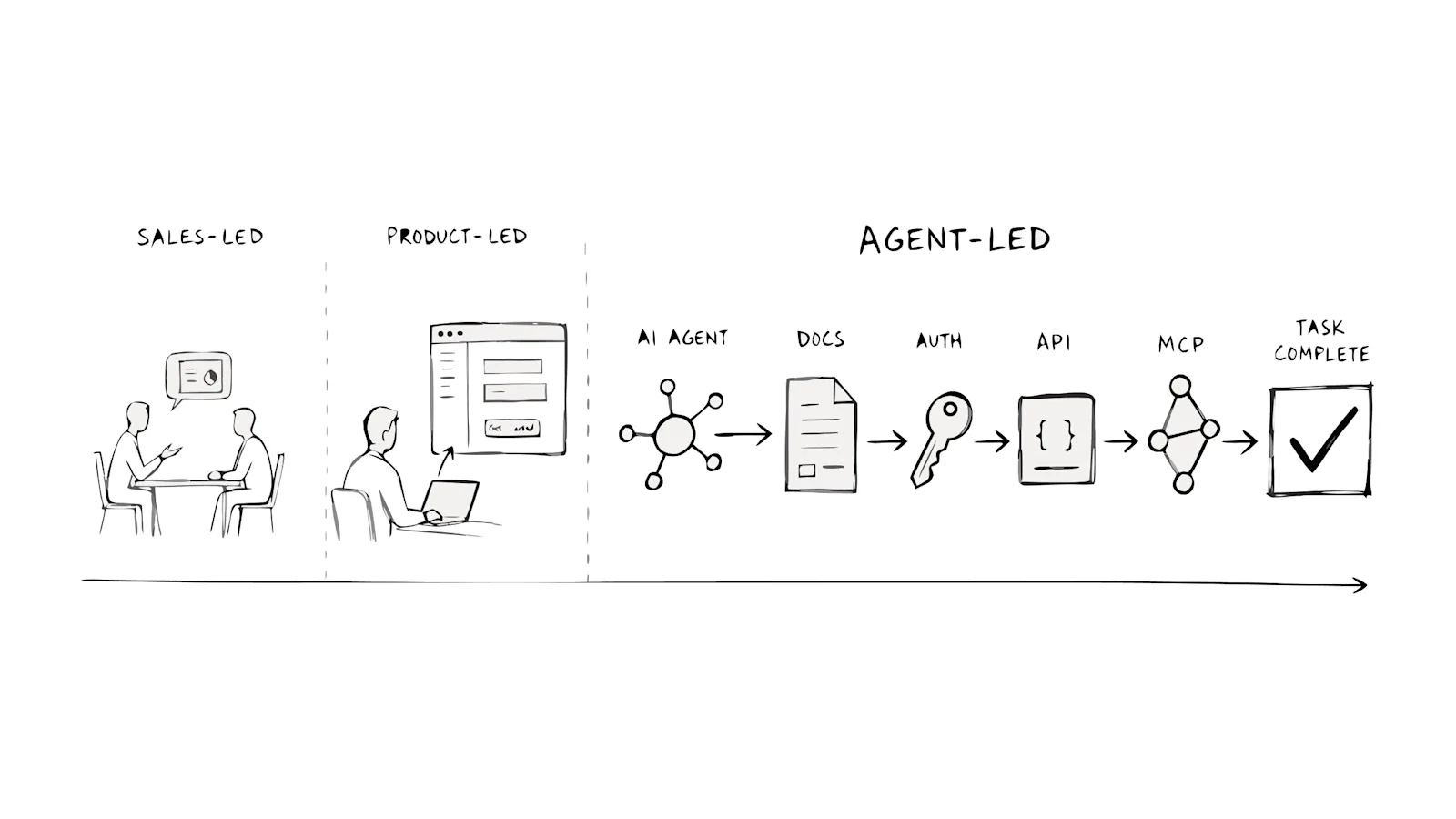
Agent-led growth is not a channel you add under paid social. It is a motion. Sales-led growth put a salesperson in the middle of the deal. Product-led growth put a human inside the product. Agent-led growth puts software in that seat.
The buyer still exists. A founder, a procurement lead, a staff engineer still has a job to finish. What changed is who does the work of finding you, checking whether you fit, and taking the first action. In PLG, a person clicks through your site and signs up. In agent-led growth, an agent researches vendors, compares capabilities, hits your auth, and either integrates or leaves.
A few terms stay useful. An agent user is software acting for a person or a company. An agent task is the job it came to finish: pull pricing, test an endpoint, wire an SDK. Agents are not bots. A bot follows a script. An agent has a goal, reads context, and switches vendors when your surface is harder than the next one.
Why this showed up on your surfaces now
Three things lined up. Models can reason through a vendor comparison without a human sitting on every step. MCP gives agents a standard way to invoke tools. And a decade of API-first product work means more of your product already exists in a form a machine can read.
This is a demand-side change. Buyers are already handing research, procurement, and integration work to agents. Those agents show up whether your quarterly plan has a slide for them.
You will feel it first if you sell to developers. Docs, OpenAPI specs, and SDKs are the surfaces agents already use. If those surfaces exist, agents are likely already on them. Categories that live in PDFs, webinars, and sales decks will feel this later.
Agent-led growth vs product-led growth
PLG optimizes for human self-service. You design a UI a person can learn, shorten signup, and let value show up before sales gets involved.
Agent-led growth optimizes for a machine that will never love your empty state. The agent does not care about your tooltip copy. It cares whether your docs are explicit, your API matches those docs, and your auth does not require a browser.
Dimension | Product-led growth | Agent-led growth |
|---|---|---|
Primary user | Human navigating a UI | Agent executing a job |
Discovery | SEO, content, word of mouth | Structured data, APIs, MCP tools |
Evaluation | Trials, demos, reviews | Docs parsing, API testing |
Conversion signal | Signup, activation | Finished job |
Key metric | Activation rate, PQLs | Whether the agent finished |
The two motions run in parallel. You still want humans to stay. A growing share of how they find you and check you now happens through software acting for them.
A Tuesday that never hits your CRM
Picture a staff engineer who asked their coding agent to add card payments to a staging app. At 11:40 p.m. the agent opens three vendor docs. Yours ranks well. The agent reads your auth section, hits an OAuth redirect built for a browser, retries twice, and switches to the vendor whose API-key path was written in one paragraph.
Your GTM stack records a docs hit, a 401, and nothing that looks like a lost deal. No form. No "talk to sales." No competitor named in Gong. The work happened. The motion just was not yours.
That is agent-led growth in the wild. The buyer still wanted payments. The agent did the evaluation. You lost a design-in without a human ever entering the funnel you report on Monday.
How discovery, evaluation, and the first transaction move
Discovery is a parse, not a click
Agents do not find you through a homepage hero. They find you through structured data, API directories, and tool listings. The way you name capabilities in a spec matters more than the testimonial reel.
If a capability only exists in a video or a one-pager, the agent cannot use it as a reason to pick you.
Evaluation is a test, not a trial
Agents evaluate by checking claims. They read what you say you support, then call the endpoint. A human will forgive a vague sentence and keep clicking. An agent will not. If the docs and the API disagree, the agent treats that as a failed evaluation and leaves.
The first transaction dies on auth
MCP is one way agents invoke tools directly. Useful when you have it. Not required for the motion to start. What blocks the first real action is still auth that assumes a person: browser consent, email magic links, manual key approval.
If the agent cannot get a credential, the transaction never starts. Your funnel never sees a signup to miss.
What GTM still measures, and what it misses
Your stack still assumes a person moving screen by screen. Sessions, PQLs, demo requests. An agent evaluating your SDK does not behave like that visitor. It reads, fails a human auth path, calls two endpoints, and is gone.
Product analytics files it as bot noise. Observability files it as a 401 and a pair of requests. Neither tells you a vendor evaluation happened.
You do not need a new glossary for every metric. Agent Task Completion Rate is the simple version: did the agent finish what it started? How to measure it sits with analytics for agent users, not in a second GTM seminar here.
What you own if this motion is real
You still own positioning, packaging, and the story a human hears. You also now own whether an agent can finish the first job without a person in Slack.
That is not a four-step playbook. It is a change in who you design the motion for. Make capabilities findable in a spec, not only on a landing page. Give the agent a credential path that does not need a browser. Treat a finished integration as a conversion, even when no one signed up.
Teams that treat agent traffic as noise will keep polishing human funnels while design-ins happen overnight on surfaces they already ship. Teams that treat it as a motion will see those attempts as pipeline, not as a bot filter.
Frequently asked questions
Is agent-led growth replacing product-led growth?
No. Humans still need to love the product. Agent-led growth sits alongside PLG. More of the finding and checking now happens through agents acting for those humans. You run both.
Which product categories see agent-led growth first?
Developer tools, API-first platforms, and infrastructure. Their public surfaces are already machine-readable. Categories whose product truth lives in PDFs, videos, or a sales conversation will see it later.